
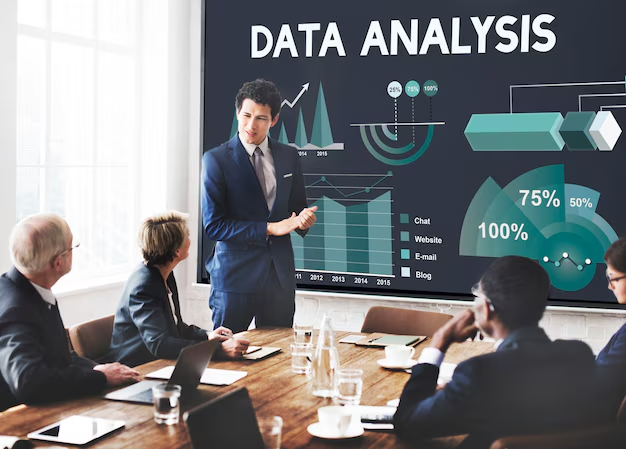

In the modern business environment, decisions are no longer made in isolation or based on experience alone. Markets change quickly, customer expectations evolve constantly, and competition grows stronger every day. Data-driven decision making provides businesses with a reliable foundation to navigate this complexity with clarity and confidence.
Data as the Foundation of Business Intelligence
At its core, data represents real business activity, customer interactions, operational performance, market behavior, and financial outcomes. When businesses rely on data, they are basing decisions on what is actually happening, not what they assume is happening.
This foundation allows leaders to understand cause-and-effect relationships within their organization. For example, changes in performance, customer engagement, or operational efficiency can be traced back to specific actions, making improvement measurable and repeatable.
From Intuition-Based to Evidence-Based Decisions
Traditional decision making often relies on intuition, past experience, or incomplete information. While experience remains valuable, it can be limited by bias or outdated assumptions. Data-driven decision making replaces uncertainty with evidence
By using verified information, businesses can compare options objectively, test assumptions, and validate outcomes. This leads to more consistent results and reduces the likelihood of decisions being influenced by guesswork or short-term pressure.
Driving Consistency Across the Organization
One of the most important benefits of data-driven decision making is consistency. When decisions are guided by shared data and metrics, teams across departments work toward the same goals using the same information.
This alignment reduces confusion, improves collaboration, and ensures that strategies are executed uniformly. Consistent decision frameworks also help businesses scale operations without losing control or clarity.
Understanding Customer Behavior at a Deeper Level
Data allows businesses to move beyond surface-level customer feedback and gain deeper insights into behavior patterns, preferences, and expectations. These insights help organizations understand why customers act the way they do, not just what they do.
With this understanding, businesses can improve engagement strategies, refine offerings, and create more meaningful customer experiences based on real evidence rather than assumptions.
Enabling Smarter Risk Management
Every business decision involves risk. Data-driven decision making helps organizations evaluate risks more accurately by analyzing historical trends, performance indicators, and predictive signals.
When risks are identified early, businesses can take preventive action rather than reacting to problems after they occur. This proactive approach supports stability, resilience, and long-term sustainability.
Supporting Long-Term Strategic Thinking
Data is essential for long-term planning because it provides measurable benchmarks and performance indicators. Businesses can track progress over time, identify patterns, and adjust strategies based on reliable feedback loops.
This allows organizations to shift from short-term reactions to long-term strategic thinking. Data-driven strategies are easier to refine, scale, and sustain as business conditions evolve.
Creating a Culture of Accountability and Learning
At the organizational level, data-driven decision-making promotes accountability. When outcomes are measured and visible, teams take greater ownership of results.
Data also encourages continuous learning. Businesses can analyze what worked, what didn’t, and why, turning every decision into an opportunity for improvement rather than a one-time action.
Conclusion
At its core, data-driven decision-making transforms how businesses think, plan, and grow. It replaces uncertainty with clarity, aligns teams around shared goals, and supports informed choices that drive sustainable success.
Tokma Technologies believes that when businesses treat data as a strategic asset, they gain the insight and confidence needed to compete, adapt, and thrive in an increasingly complex digital world.


